
Endocrine – Patient 1
Patient Data
1200: The client is an 11-year-old child who was found unconscious at home by her parent and brought to the emergency department (ED). The parent states the child has been drinking excessive fluids and urinating frequently, even throughout the night. The child had reported abdominal pain earlier in the day and had one episode of vomiting before losing consciousness. Even though her appetite has increased dramatically in the last week, the child has lost weight. Upon assessment, dry mucous membranes, poor skin turgor, and soft and sunken eyes are noted. Assessment findings also reveal the child has Kussmaul respirations. There are no significant findings in the child’s medical history.
clear
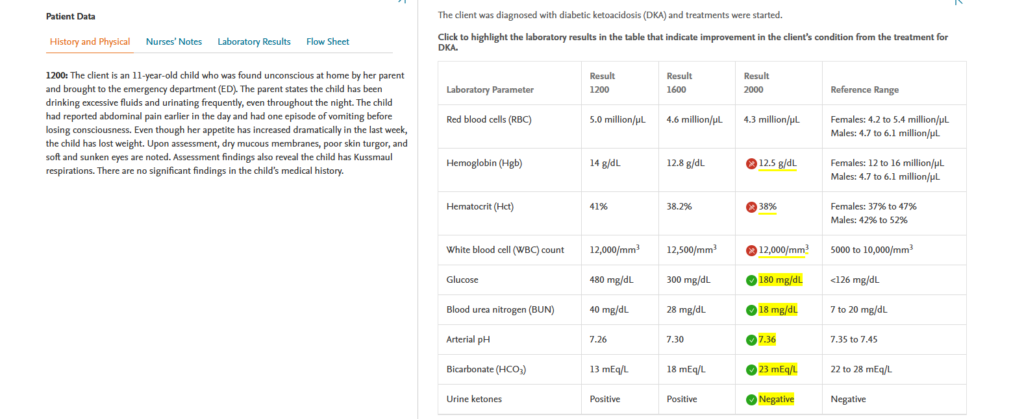
So close!
Rationale:
Fluid therapy is used as the first line of treatment for DKA to restore blood volume and perfusion to vital organs. This is followed by insulin therapy to lower blood glucose levels. These treatments will reduce serum glucose and BUN levels. The arterial pH will be between 7.35 and 7.45, and the serum bicarbonate (HCO3) level will be between 22 and 28 mEq/L. The ketones found in the urine will be eliminated by hydration. The RBCs transport oxygen throughout the body; however, these findings do not indicate an improvement in diabetic ketoacidosis. The Hgb and Hct are used to diagnose anemia; however, these findings do not indicate improvement in diabetic ketoacidosis. The WBCs are used to rule out an infection, not to see if DKA is improving.
16m 35s
Clinical Judgment Skill(s):
Recognize Cues, Analyze Cues, Generate Solutions, Take Actions
2 / 5 points
Endocrine – Patient 2
Patient Data
Select a tab to see patient information
done
That’s right!
Rationale:
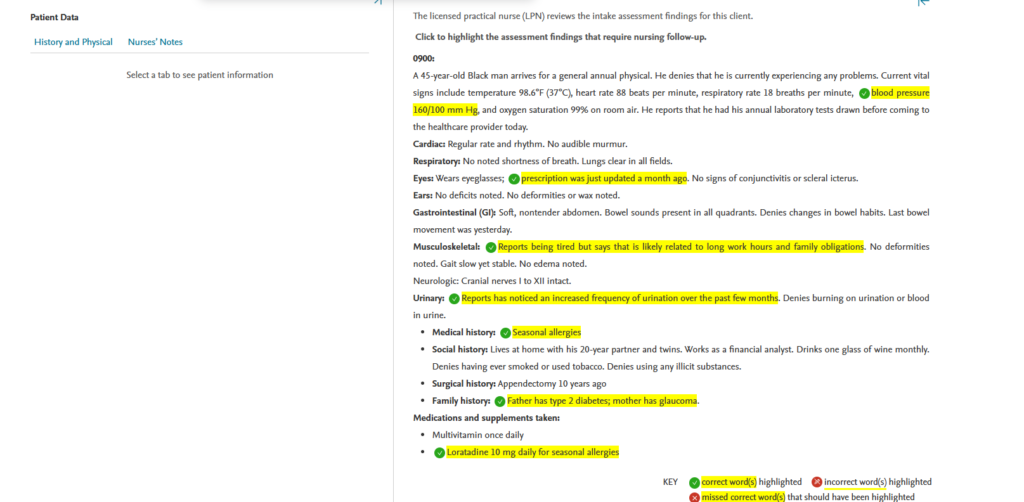
The LPN will conduct an interview with the client to identify any issues that need to be addressed further. Blood pressure is considered normal if it is less than 120/80 mm Hg. With a blood pressure of 160/100 mm Hg, the client’s blood pressure exceeds both parameters and necessitates further assessment. A change in a visual prescription 1 month ago may be a normal finding or it may indicate a recent change in vision or a visual problem. The LPN will follow up to see if the client was seen as part of an annual eye examination or if there was a concern that necessitated further intervention or attention. Fatigue is not uncommon in a 45-year-old busy adult; however, the LPN will screen to determine whether this is a new finding or a change from baseline. An increased frequency of urination may indicate the presence of an infection or a metabolic problem, so the LPN will conduct further assessment. The LPN will continue to evaluate the impact of seasonal allergies and whether loratadine treatment is effective. Finally, the LPN will note that the client has a first-degree relative with type 2 diabetes and another with an eye condition; ongoing assessment will assist the LPN in determining whether recognition of these cues should be included in analysis and prioritization of care. Bowel sounds in all quadrants and having a bowel movement yesterday are normal findings that do not necessitate further assessment. A slow but stable gait is a normal finding that does not necessitate further assessment. Drinking one glass of wine per month is not excessive and does not necessitate further assessment by the LPN.
4m 49s
Clinical Judgment Skill(s):
Recognize Cues
7 / 7 points
Endocrine – Patient 2
Patient Data
Select a tab to see patient information
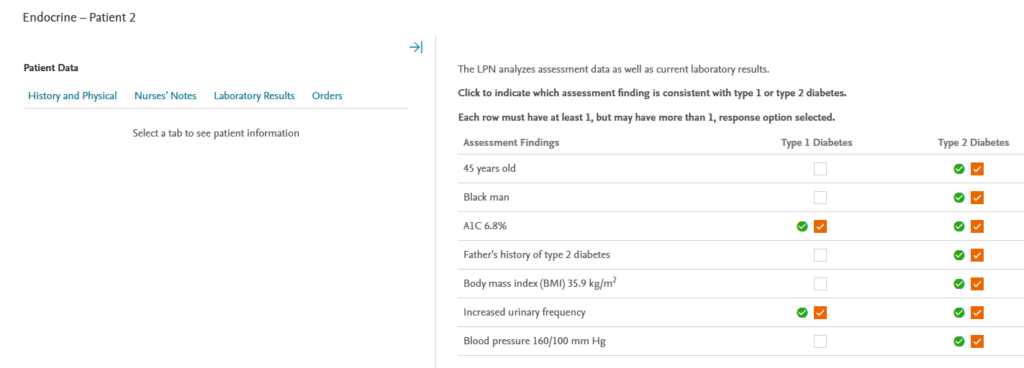
The LPN analyzes assessment data as well as current laboratory results.
Click to indicate which assessment finding is consistent with type 1 or type 2 diabetes.
Each row must have at least 1, but may have more than 1, response option selected.
Assessment Findings
Type 1 Diabetes
Type 2 Diabetes
45 years old
Correct answercheck_circle
Black man
Correct answercheck_circle
A1C 6.8%
Correct answercheck_circle
Correct answercheck_circle
Father’s history of type 2 diabetes
Correct answercheck_circle
Body mass index (BMI) 35.9 kg/m2
Correct answercheck_circle
Increased urinary frequency
Correct answercheck_circle
Correct answercheck_circle
Blood pressure 160/100 mm Hg
Correct answercheck_circle
done
That’s right!
Rationale:
Although type 1 and type 2 diabetes share some characteristics, each diabetic type has its own distinct set of characteristics. Type 1 diabetes is distinguished by a young age of onset, elevated A1C (when uncontrolled), urinary frequency, increased thirst, and episodes of hypoglycemia. Type 2 diabetes is distinguished by late-life onset (45 years old), no episodes of hypoglycemia (unless taking insulin or diabetic medication), metabolic syndrome (combination of hypertension [160/100 mm Hg], dyslipidemia, insulin resistance (A1C 6.8%), hyperinsulinemia, glucose intolerance, and obesity [BMI 35.9 kg/m2]), urinary frequency, and having a first-degree relative with type 2 diabetes.
Type 2 diabetes is more prevalent in the Black, Hispanic, Native American, Asian American, and Pacific Islander populations, according to evidence.
1m 17s
Clinical Judgment Skill(s):
Analyze Cues
9 / 9 points
Endocrine – Patient 2
Patient Data
Select a tab to see patient information
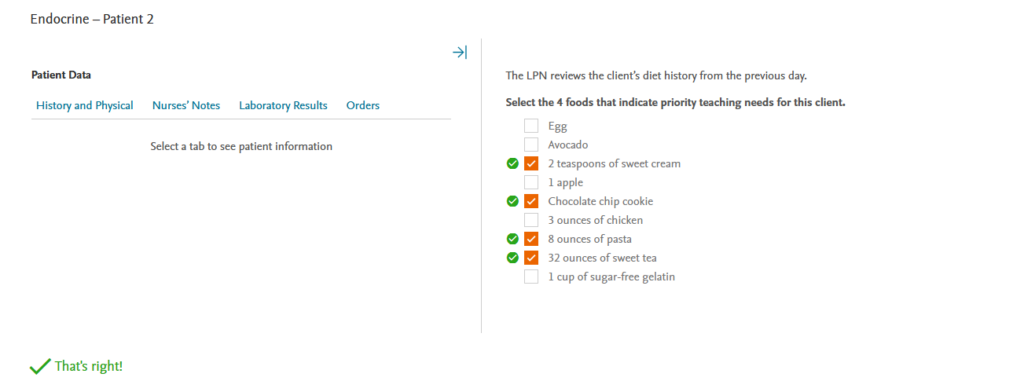
The LPN reviews the client’s diet history from the previous day.
Select the 4 foods that indicate priority teaching needs for this client.
Egg
Avocado
Correct answercheck_circle
2 teaspoons of sweet cream
1 apple
Correct answercheck_circle
Chocolate chip cookie
3 ounces of chicken
Correct answercheck_circle
8 ounces of pasta
Correct answercheck_circle
32 ounces of sweet tea
1 cup of sugar-free gelatin
done
That’s right!
Rationale:
The foods that require priority teaching include 2 teaspoons of sweet cream, chocolate chip cookie, pasta, and sweet tea, as all these items are very high in carbohydrates. Clients with type 2 diabetes must watch their carbohydrate intake and choose foods that are high in nutrient density. The typical client with this condition requires about half of their calories to come from healthy carbohydrates. This equates to 200 to 225 carbohydrate grams per day for an 1800-calorie diet. Instead of processed sugars (such as included in sweet cream, cookies, regular pastas, and sweet tea), clients should be taught to choose carbohydrates with fiber (e.g., raw fruit) and healthy grains (e.g., whole wheat grains; starchy vegetables; and beans, lentils, and peas).
An egg, a portion of an avocado, an apple, and chicken are healthy choices that fit well within the dietary recommendations for people with type 2 diabetes. Although an apple contains carbohydrates, it is also a healthy choice that contains dietary fiber.
30s
Clinical Judgment Skill(s):
Prioritize Hypotheses
4 / 4 points
Endocrine – Patient 2
Patient Data
Select a tab to see patient information
The LPN reinforces the importance of home glucose monitoring to the client.
Choose the most likely options for the information missing from the statement by selecting from the lists of options provided.
done
That’s right!
Rationale:
Blood sugar levels in type 2 diabetes clients are expected to range between 80 and 130 mg/dL. When the client becomes hypoglycemic, as in the case of having a blood sugar level of 60 mg/dL, it is critical to raise the glucose level by having the client consume something like orange juice or a glucose tablet while continuing to monitor symptoms. The client should not fast because blood sugar levels may continue to fall. Because the client is mildly (not severely) hypoglycemic, calling 911 is not necessary at this time. Thirty-two ounces of water will not help the client recover from hypoglycemia. Insulin is not needed for a client with type 2 diabetes at this time and it is not given when blood sugar is low.
24s
Clinical Judgment Skill(s):
Generate Solutions
2 / 2 points
Endocrine – Patient 2
Patient Data
Select a tab to see patient information
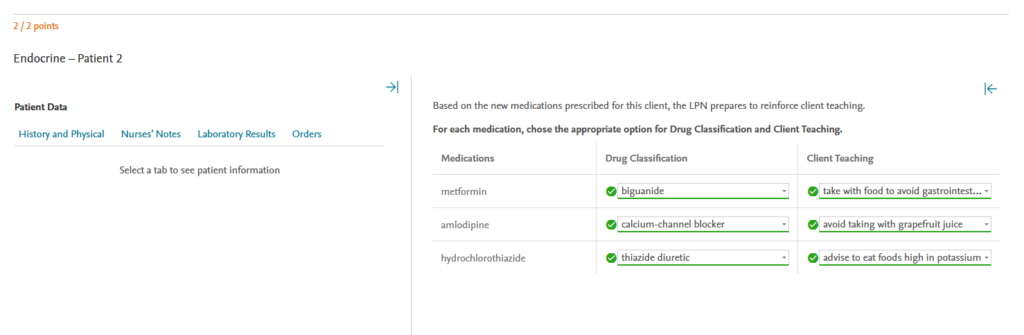
Based on the new medications prescribed for this client, the LPN prepares to reinforce client teaching.
For each medication, chose the appropriate option for Drug Classification and Client Teaching.
| Medications | Drug Classification | Client Teaching |
|---|---|---|
| metformin | Correct answercheck_circlebiguanide | Correct answercheck_circletake with food to avoid gastrointestinal (GI) upset |
| amlodipine | Correct answercheck_circlecalcium-channel blocker | Correct answercheck_circleavoid taking with grapefruit juice |
| hydrochlorothiazide | Correct answercheck_circlethiazide diuretic | Correct answercheck_circleadvise to eat foods high in potassium |
done
That’s right!
Rationale:
Metformin is a biguanide, not an incretin mimetic or insulin stimulator. To reduce the risk of GI issues, the client should be taught to take with food. Incretin mimetics are injected, and insulin stimulators can cause hypoglycemia.
Amlodipine is a calcium-channel blocker whose action is enhanced when taken with grapefruit juice; therefore, grapefruit juice should be avoided. ACE inhibitors can induce a dry cough, which should be reported to the healthcare provider for evaluation. Beta blockers can cause orthostatic hypotension.
Hydrochlorothiazide is a thiazide diuretic that can cause potassium excretion; therefore, the client must be taught to eat potassium-rich foods. Fluids should be encouraged rather than discouraged when clients are taking diuretics, unless there is another underlying health condition that necessitates fluid restriction. Diuretics should not be taken at night because they cause nocturia, which can be bothersome.
1m 24s
Clinical Judgment Skill(s):
Take Actions

6 / 6 points
Endocrine – Patient 2
Patient Data
Select a tab to see patient information
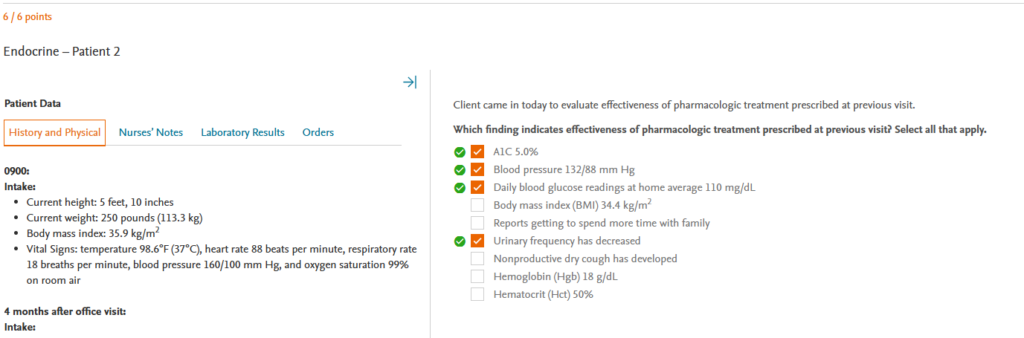
Client came in today to evaluate effectiveness of pharmacologic treatment prescribed at previous visit.
Which finding indicates effectiveness of pharmacologic treatment prescribed at previous visit? Select all that apply.
Correct answercheck_circle
A1C 5.0%
Correct answercheck_circle
Blood pressure 132/88 mm Hg
Correct answercheck_circle
Daily blood glucose readings at home average 110 mg/dL
Body mass index (BMI) 34.4 kg/m2
Reports getting to spend more time with family
Correct answercheck_circle
Urinary frequency has decreased
Nonproductive dry cough has developed
Hemoglobin (Hgb) 18 g/dL
Hematocrit (Hct) 50%
done
That’s right!
Rationale:
A lower A1C, which is trending downward, lower blood pressure, controlled blood glucose at home, and a decrease in urinary frequency are all indicators of effective pharmacologic treatment. The BMI remains unchanged, and the Hgb and Hct levels remain within normal ranges. The fact that he has more time to spend with his family is unrelated to efficacy of pharmacologic treatment, as is the development of a nonproductive dry cough.
53s
Clinical Judgment Skill(s):
Evaluate Outcomes